
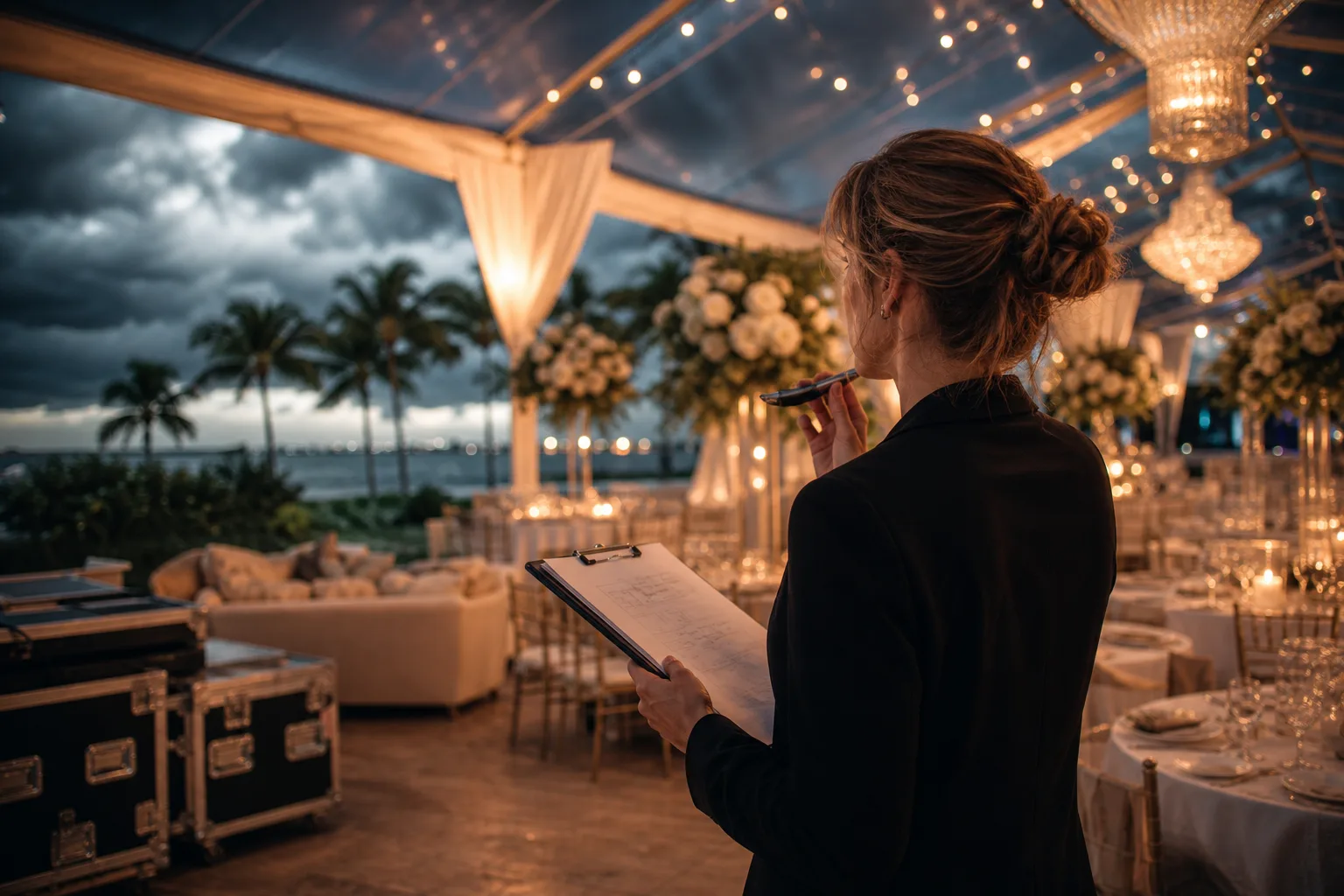
You have approved the venue, floral concept, rentals, lighting, and production plan. Then a storm track shifts toward Miami, a freight shipment misses its delivery window, or the venue changes its load-in rules. Suddenly, money starts moving from the details your guests will notice. Coastal logistics and destination freight make that pressure especially real for weddings, brand events, and private celebrations. That is where the question “what is a contingency budget” becomes practical: it’s money reserved for accepted event risks that don’t yet belong to a specific line item.
Most event hosts don’t have a spending problem. They have an uncertainty-planning problem. A clear budget separates committed costs, allowances for undecided selections, contingency reserves, management reserves, and genuine scope changes. The related event cost breakdown for luxury events follows the same budgeting workflow, while this guide focuses on what happens when an approved plan starts moving.
Why a Contingency Budget Protects the Guest Experience
When an approved wedding or brand event meets a storm track, delayed freight, or a sudden venue restriction, guests feel the pressure quickly. You may lose covered pathways, comfortable temperatures, visual consistency, or the timing that keeps dinner and entertainment moving.
A contingency budget keeps one difficult decision from damaging the whole experience. For Prim Miami, that means protecting the design intent across Miami, FL, the Caribbean, and Mexico without treating the reserve as spare money. The same thinking applies when you review event design and production planning before committing to a final scope.
What contingency means in simple terms
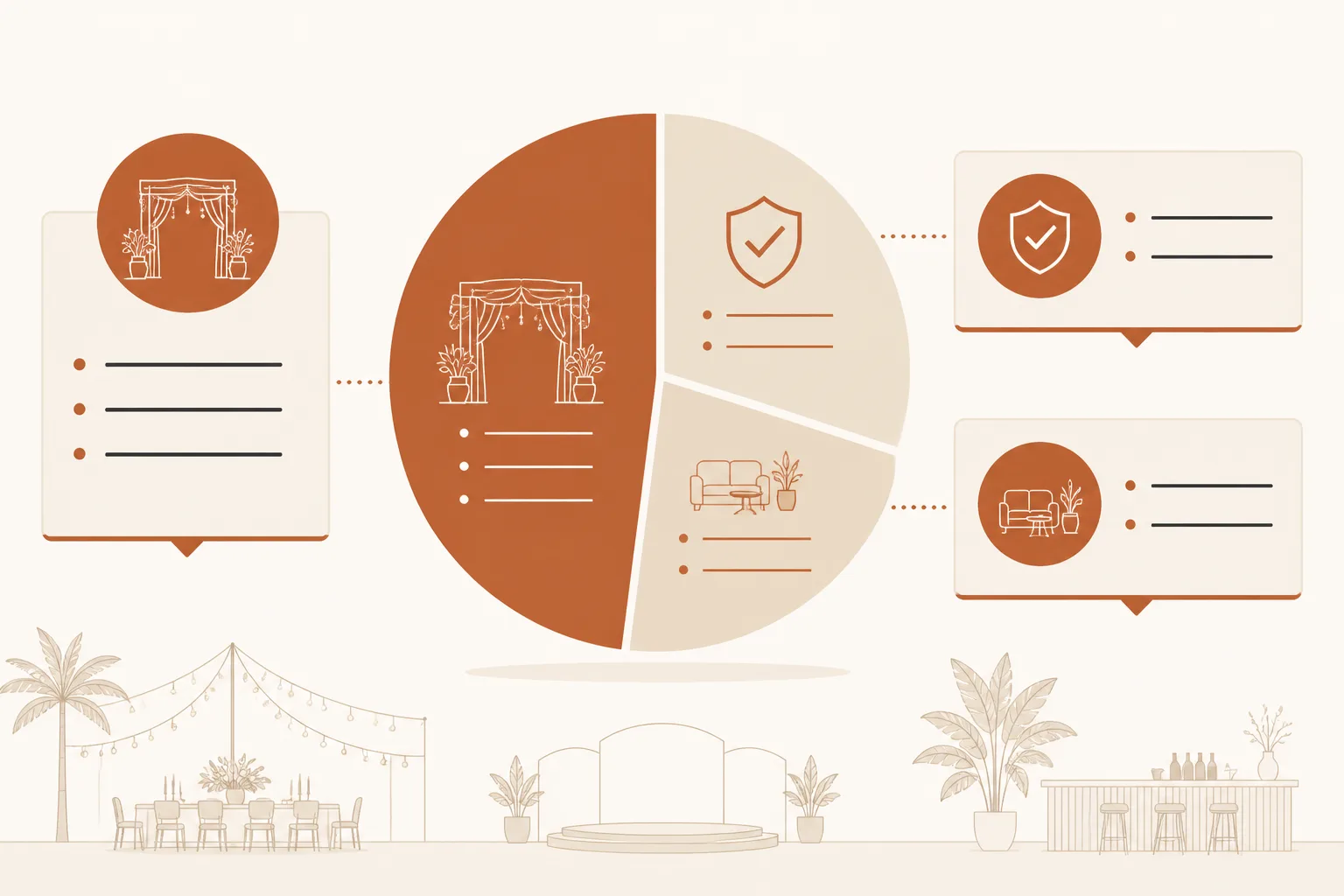
Contingency means money set aside for a risk you reasonably expect may happen, even though you don’t know the exact cost yet. The Parliamentary Budget Office describes its Contingency Reserve as an allowance for expected items that haven’t been assigned to specific programs or details. For an event, that could mean a rain plan requiring tenting, flooring, fans, generators, and additional labor.
You might also need local replacement rentals when freight misses its delivery window. A floral substitution can change both stem costs and installation time, while overtime may affect power, catering, and guest flow. The reserve gives you choices before a rushed compromise becomes the only choice.
The meaning of a contingency reserve
A contingency reserve is a labeled allowance inside your event budget, not an upgrade fund or unassigned profit. The Parliamentary Budget Office says including anticipated uncertainty makes an overall budget estimate more accurate instead of simply leaving expected costs out. For event planning, project-management guidance often places this reserve at around 10% to 15%, but your actual percentage should reflect venue exposure, destination logistics, weather risk, and production complexity.
“Including expected uncertainty makes the overall estimate more accurate,” according to the Parliamentary Budget Office.
The practical rule for protecting event quality
Before you approve a change, connect the reserve to a named risk and its guest-facing consequence. A South Florida gala may need a generator for comfort and lighting. A Caribbean wedding may need local lounge furniture after a shipment delay. A Mexico celebration may need additional labor after a restricted load-in.
Weak reserve label: “Extra money, $25,000.” Strong reserve label: “Weather, freight, and overtime reserve, $25,000, released only against documented event risks.” Prim Miami can coordinate those responses from first sketch to last light, although no production partner can remove every weather or freight uncertainty.
Practical rule: Protect the reserve for risks that preserve guest comfort, visual consistency, or delivery quality, not for upgrades added after approval.
Four Money Buckets Hidden Inside an Event Budget
Every dollar in an event budget should have a job. A signed floral contract, an undecided linen choice, and a possible rain tent are different kinds of cost.
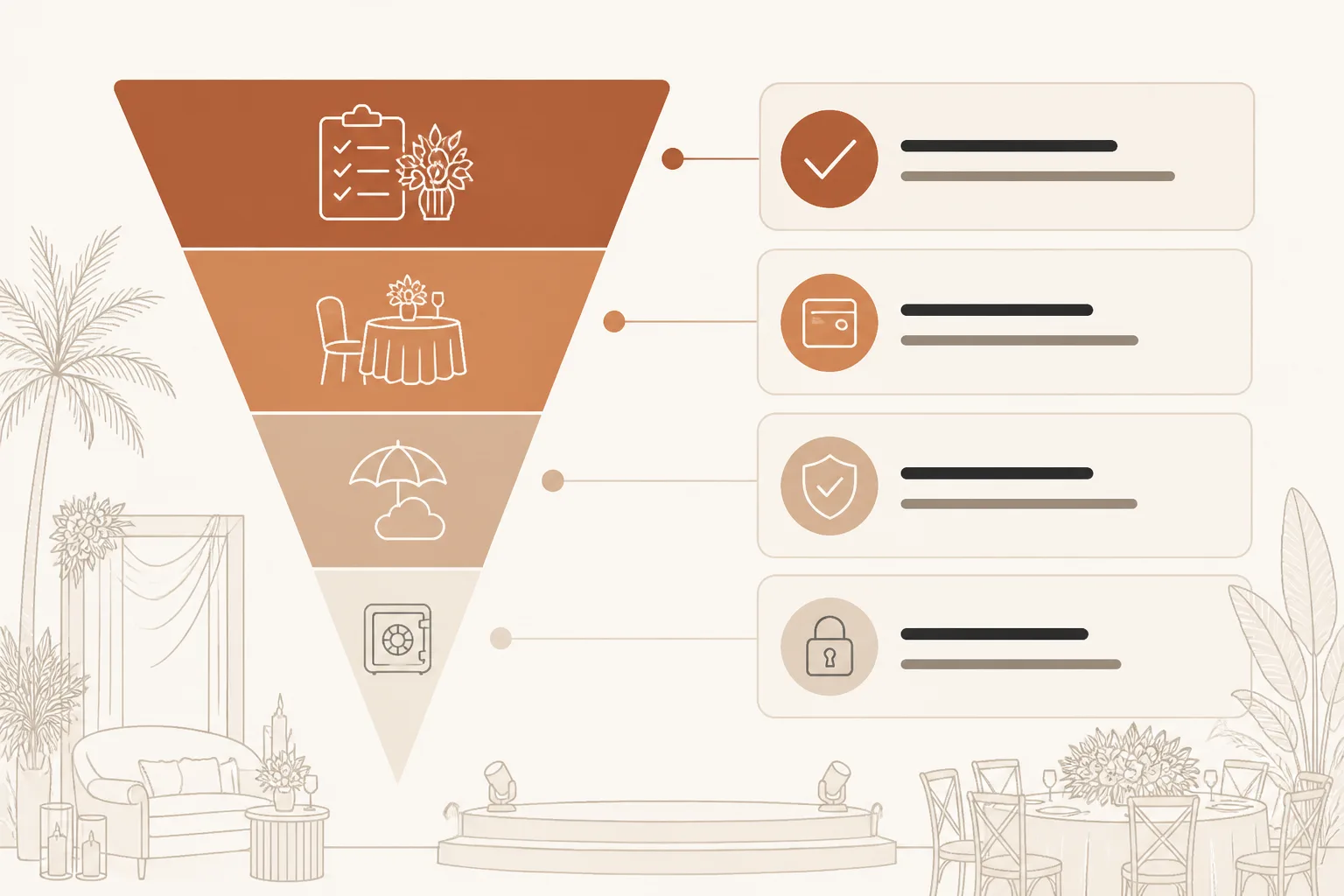
This four-bucket model separates approved scope from accepted risk and keeps contingency from quietly paying for upgrades, new requests, or unclear planning.
What belongs in committed costs and allowances
Known costs include signed venue, rental, design, floral, labor, and production commitments. An allowance covers a category you expect to buy but haven’t finalized, such as a menu enhancement, specialty linen, lounge piece, or imported floral variety. An allowance can also cover a defined style category, such as vintage furnishings sourced through My Vintage, when the category is approved but the final pieces remain undecided.
- Known cost: A signed $18,000 lighting contract belongs in the approved event budget.
- Allowance: A $4,000 lounge furniture allowance covers an undecided selection, not an unexpected problem.
A Parliamentary Budget Office explanation describes a Conservative Bias Allowance as a way to account for the tendency to under-forecast expenses. Its analysis says this approach generally improves estimate accuracy in practice, based on 30 years of experience. The distinction matters because an allowance addresses an expected category, while contingency addresses uncertainty around an accepted risk, according to the Parliamentary Budget Office.
What happens when you need a contingency reserve for known unknowns
A contingency reserve covers risks you can name but cannot price precisely. Rain response, freight delays, replacement shipments, overtime, and extra labor belong here.
Weak reserve label: “Extra money, $25,000.” Strong reserve label: “Weather, freight, and overtime reserve, $25,000, released only against documented event risks.” Contingency is not profit or automatic funding for a guest-requested upgrade or a new brand activation idea.
How does management reserve differ from contingency reserve
Management reserve sits above project-level contingency and remains controlled by the sponsor or leadership group. It suits a multi-day destination wedding, a corporate program with several stakeholders, or a brand activation where the brief may expand after new approvals.
| situation | better move | why |
|---|---|---|
| Signed venue, rental, floral, design, or production commitment | Place the amount in known costs | The cost is identified and should not consume contingency |
| Menu enhancement, linen, lounge piece, or floral selection is expected but undecided | Create an allowance | The category is known even though the final selection or price is not |
| Rain response, freight delay, replacement shipment, overtime, or labor exposure | Reserve contingency against the accepted risk | The event may incur the cost, but the exact amount and timing remain uncertain |
| A new sponsor request, guest-requested upgrade, or major program expansion | Process it as a scope change or use separately governed management reserve | New scope should not quietly consume money intended to protect existing commitments |
Does the 70/20/10 budget rule work for events
The 70/20/10 rule is a planning lens that places about 70% of your budget in defined costs, 20% in allowances and expected adjustments, and 10% in risk reserve. It isn’t a universal event law, so you still need a risk-based review for Miami weather, destination freight, floral sourcing, labor access, and venue restrictions.
For a luxury wedding, Prim Miami can help distinguish design decisions from production exposure, although no studio can remove every uncertainty. Your reserve works best when approvals, scope changes, and releases are documented.
How to Calculate a Contingency Budget for a South Florida Event
A useful contingency starts with your event’s actual exposure, not a percentage copied from another celebration. A Miami wedding, brand activation, gala, or private party may face weather, freight, floral, labor, power, overtime, and production risks at different levels. Food and beverage planning can create similar uncertainty when menus, staffing, or service requirements change; those categories may be tracked separately from production risk, as with Food Festa.
Treat the reserve as money held for approved uncertainty, not as extra spending room. The Parliamentary Budget Office explains that a contingency reserve is recorded as an expense-side flow rather than as a stock of funds on a balance sheet. That supports keeping the reserve visible, controlled, and reconciled.
How to calculate contingency from risk exposure
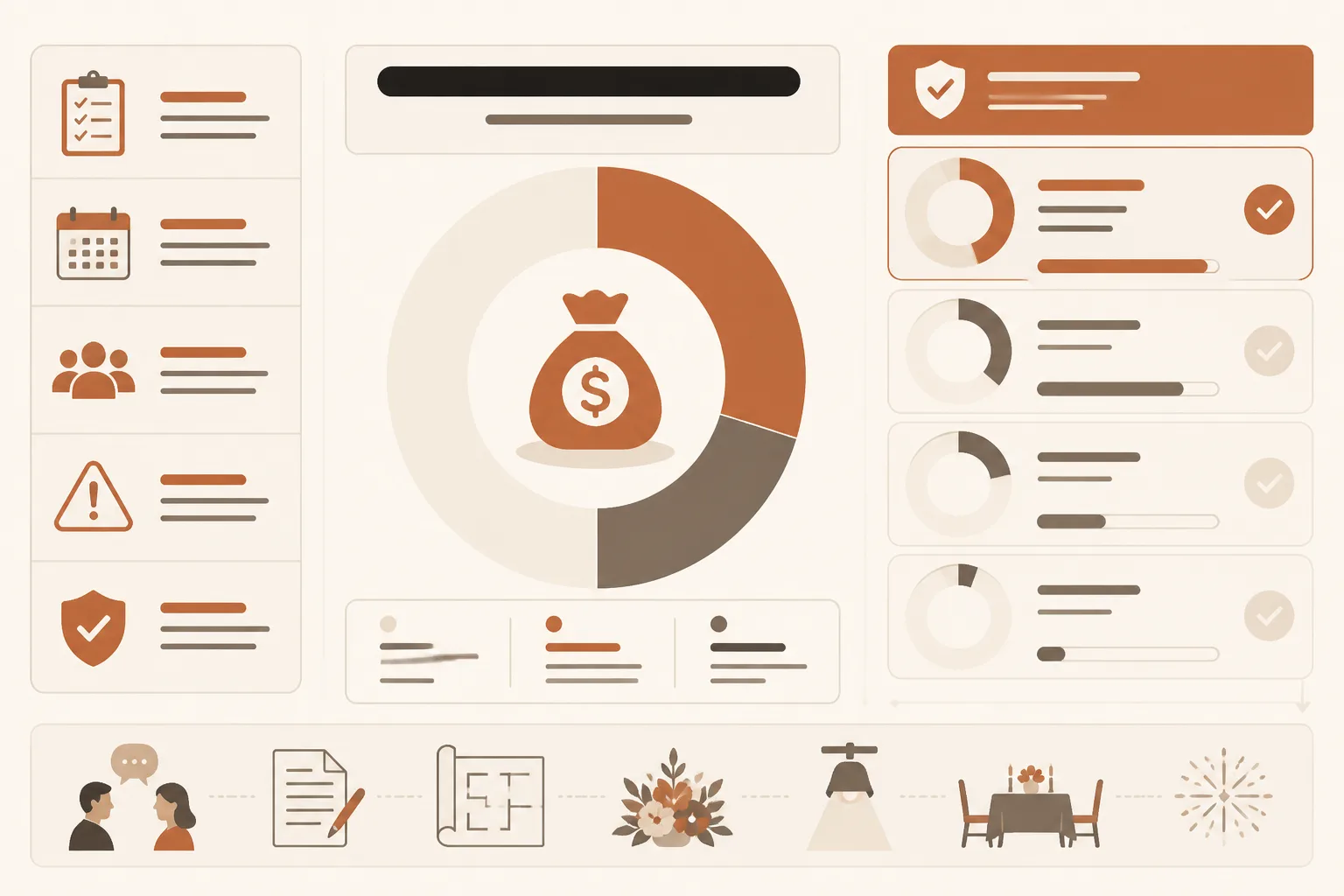
Calculate contingency by listing each credible risk, estimating its plausible cost, and assigning a confidence level before reserving money. A risk register might show $4,000 for a weather tent adjustment, $3,500 for delayed freight, $2,000 for floral substitution, and $500 for overtime exposure.
The total doesn’t need to predict every dollar. It needs to show why the reserve exists. A design brief supports the same workflow because the approved concept clarifies which production choices carry financial exposure; this guide to event design briefs and examples fits that planning stage.
The meaning of a 10% contingency
A 10% contingency means you hold $10,000 against a $100,000 working event budget. The remaining $90,000 covers planned scope, while the separate $10,000 reserve protects decisions that cannot be priced confidently yet.
Weak: Contingency: $10,000.
Strong: Contingency reserve: $10,000 held for weather, freight, labor, and approved production changes, with every draw documented.
What makes a good contingency budget
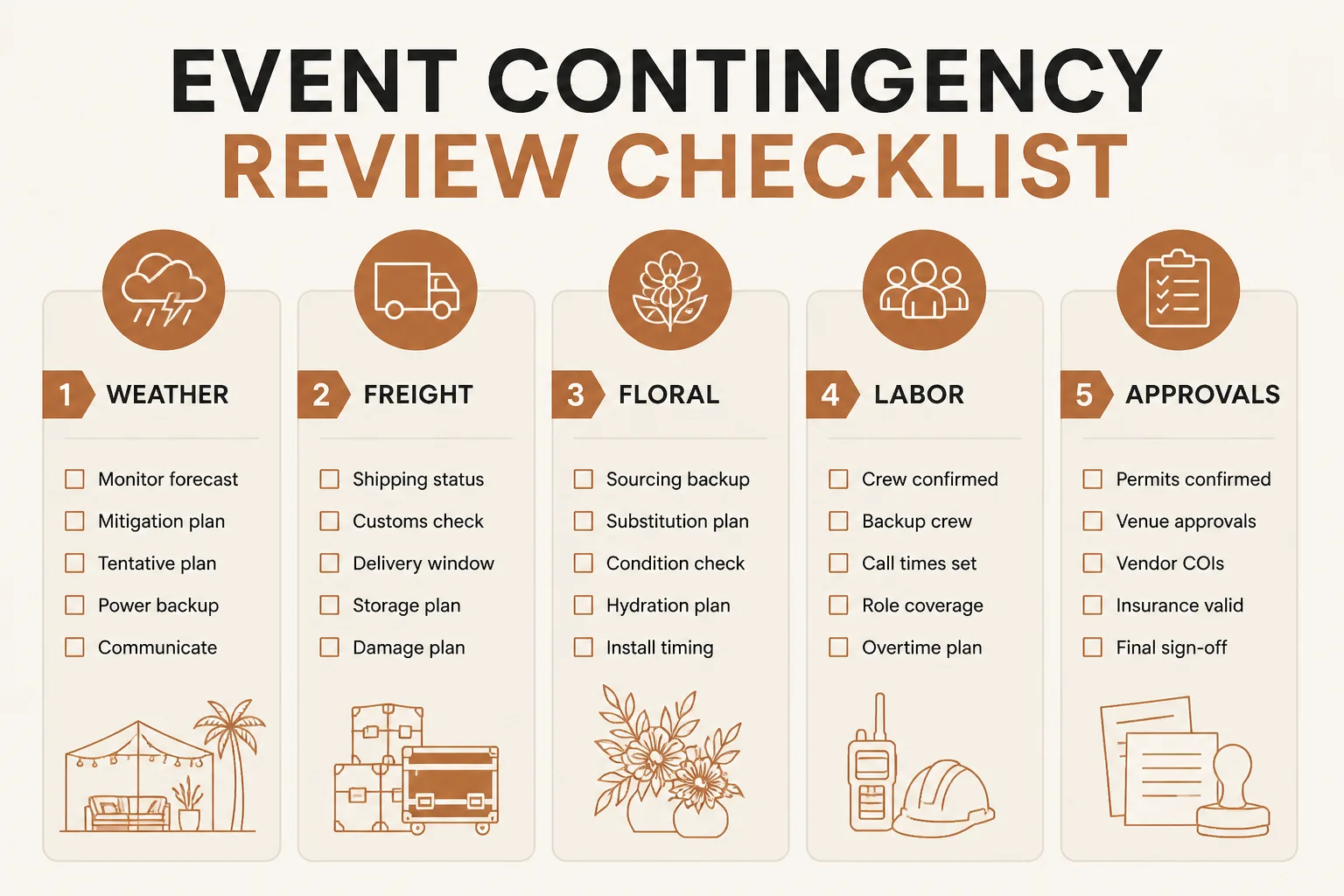
A good contingency budget matches your documented risk lines, preserves guest-facing quality, and leaves unused money subject to closeout reconciliation. Your checklist should confirm the following:
- Weather: Price a tent, flooring, cooling, rain protection, or indoor relocation option.
- Freight: Check delivery windows, replacement sourcing, storage, and rush transport exposure.
- Floral: Record substitution allowances for seasonal shortages, heat damage, or delayed imports.
- Labor: Confirm crew access, union rules where applicable, setup windows, and added calls.
- Power: Check generator capacity, distribution, backup needs, and venue restrictions.
- Overtime: Confirm hourly rates for vendors, venue staff, transportation, and production crews.
- Last-minute production changes: Reserve for revised layouts, added lighting, signage, or safety requirements.
| priority | what to check | why |
|---|---|---|
| Standard-risk event | Use a documented starting reserve near 10% of the working event budget, then test it against actual risk lines | Ten percent is common project-management context, but the event profile should determine the final amount |
| Higher-risk South Florida or destination event | Stress-test a reserve near 20% for outdoor weather, imported freight, remote venues, compressed setup, or multiple production days | More exposed logistics can create several simultaneous cost pressures |
| $100,000 event with 10% reserve | Show a separate $10,000 contingency line and record every approved draw | The client can see what flexibility costs without confusing it with committed scope |
| $100,000 event with 20% reserve | Show a separate $20,000 reserve and identify which risks justify the additional $10,000 | A larger cushion preserves options but ties up funds that may remain unused |
| 20% contingency fee proposal | Confirm the fee base, inclusions, exclusions, and whether it is a production fee or client-held risk reserve | A fee charged on a budget is not automatically equivalent to contingency money controlled for event risks |
The meaning of a 20% contingency
A 20% contingency means you hold $20,000 against a $100,000 event budget. The additional $10,000 over a 10% reserve may make sense when you face a storm-sensitive outdoor venue, imported décor, remote destination freight, or a compressed installation schedule.
That larger reserve protects flexibility, but the funds remain unavailable for entertainment, design upgrades, or guest amenities until the risk period passes. Prim Miami can model those exposures across South Florida and destination events, although no studio can guarantee that every cost change will fit the reserve.
The meaning of a 20% contingency fee
A 20% contingency fee is usually a vendor or producer charge calculated on a defined base, not automatically a client-held reserve. Your proposal must state whether the 20% applies to production costs, labor, rentals, or the full event budget, and whether unused amounts are returned or retained.
Weak: Production fee: 20% contingency.
Strong: Production fee: 20% of the approved $40,000 production base, excluding venue and catering, with risk reserve treatment and closeout terms stated separately.
Five Contingency Mistakes That Undermine High-End Events
A reserve can exist on paper and still fail when a decision arrives. You may see a tidy production budget while nobody knows which dollars protect rain plans, freight delays, floral substitutions, or extra labor.
Clear ownership matters as much as the amount set aside. Including defined items in a contingency reserve supports accountability and better resource allocation, according to the Parliamentary Budget Office’s 2024 budget guidance. Protecting the guest experience requires a reason, an approver, and a visible remaining balance for every draw. The same discipline helps when coordinating an external supplier such as Superas, because its agreed scope and payment responsibility should remain distinct from the event’s risk reserve.
Calling an allowance contingency
- Hidden reserve: You bury risk money inside “lighting allowance” or “floral incidentals,” making the budget look tidy but hiding its purpose. Guests may lose a rain-ready lighting plan because the team can’t tell which dollars remain. Weak: Lighting allowance: $4,000. Strong: Lighting risk reserve: $4,000, held separately for weather, access, or equipment changes.
- Corrective practice: Show contingency as its own line, while Prim Miami connects each possible draw to creative direction, floral, lighting, rentals, or vendor management. That visibility has limits. No studio can predict every supplier decision.
Treating the reserve as a slush fund
- Guest upgrade: You use risk money for a late lounge request, larger floral installation, or new brand deliverable. The accepted risks then remain unfunded, and stakeholders may face a rushed downgrade.
- Corrective practice: Classify new scope separately and require a written budget change. The reserve stays assigned to protection, not preference.
Ignoring South Florida weather and destination logistics
- One vague risk: You combine rain exposure with freight exposure, so a Miami storm, Caribbean customs delay, or Mexico delivery miss can consume the same untracked allowance.
- Corrective practice: Model weather and destination logistics as separate risks. Prim Miami can coordinate production, freight, rentals, and vendor timing across those markets, but local restrictions and carrier delays still require their own review.
Spending without an approval trail
- Unrecorded drawdown: You pay for emergency labor or replacement blooms without updating the reserve. Later, your team assumes the original balance still exists.
- Emergency authority: You wait until a tent, freight reroute, or lighting change is urgent before deciding who may approve it. That delay creates conflict when guests are already arriving.
- Corrective practice: Assign an approver before load-in, record each draw, state the reason, and show the remaining balance. A wedding vendor contact sheet can support the same workflow when approval contacts and escalation paths are documented clearly.
FAQ
What a contingency reserve means
A contingency reserve is money set aside for credible costs you can't price exactly when you build the event budget. It may cover weather protection, freight changes, overtime, replacement rentals, or production fixes. The reserve should have a named owner, a clear purpose, and a record of every approved draw so it doesn't become a second fund for upgrades.
What the 70/20/10 budget rule means
The 70/20/10 rule divides an event budget into 70% for planned costs, 20% for variable or adjustable items, and 10% for contingency. It's a starting framework, not a substitute for pricing real risks. A coastal Miami, FL event with complex power, freight, or weather needs may require a different reserve after the exposure is reviewed.
What contingency means in simple terms
Contingency means money held back for a problem or change you can reasonably expect but can't fully predict. If rain forces a tent, a supplier misses a delivery, or labor runs late, the reserve helps pay for the fix. It isn't free money for a nicer linen, larger guest list, or last-minute design upgrade.
What a 10% contingency means
A 10% contingency means adding an amount equal to 10% of the budget base for possible unexpected costs. On a $50,000 event budget, that would be $5,000. The calculation is only a check. If your venue, guest count, travel, weather plan, or production schedule creates higher exposure, price those risks directly and adjust the reserve.
The Five-Step Event Budget Check Before You Book
Before you release another deposit, create one clear page showing what your event already owes, what it may still require, and who controls the reserve. Without that view, you may mistake an undecided linen choice for an emergency or discover too late that weather protection has no funding.
A simple operating routine gives your wedding, brand experience, gala, or private celebration a financial boundary before production begins.
-
Lock the committed costs
Start with signed obligations: Open one budget page and record approved venue, floral, rental, lighting, production, and labor costs. Add a separate contingency line with its purpose, owner, starting balance, and drawdown record.
Weak example: “Extra budget: $12,000.”
Strong example: “Contingency reserve: $12,000. Owner: event producer. Purpose: weather, freight, floral, labor, and production changes. Drawdown record: date, reason, approver, amount, balance.”
-
List allowances separately
Separate expected choices: Record undecided linens, upgraded bar service, welcome gifts, or additional lounge pieces as allowances, not contingency. You then know which funds belong to design decisions and which protect the event from disruption.
-
Price the credible risks
Build the exposure list: Identify your South Florida weather plan, coastal venue exposure, freight, floral availability, labor, power, overtime, and destination logistics. Include venue-specific load-in restrictions and replacement options for critical décor.
-
Label and approve the reserve
Set a risk-based amount: Price the credible risks first, then use a percentage as a reasonableness check rather than a substitute for analysis. Name who may approve each draw before you book additional vendors or release production deposits.
-
Track every drawdown
Keep the balance current: Require a dated reason, supplier or category, approval, amount, and remaining balance for every withdrawal. Decide what happens to unused funds, so you and Prim Miami can review the same record from first sketch to last light.
If you want to build this control into your event, Prim Miami provides creative direction, production, floral, lighting, and vendor management for weddings, brand experiences, corporate events, and private celebrations. The Prim Miami journal of event design and production follows the same planning workflow.

Planning something like this?
Tell us the date and we'll tell you if we're free.


